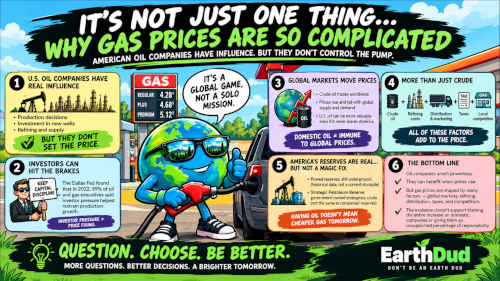
We have the resources. We have the technology. So why do Americans still pay global market prices at the pump?
When gas prices climb, it’s a fair question to ask: If America produces so much oil, why does filling up the tank still cost so much?
Are oil companies responsible? Are we paying for oil from other countries? Could America simply produce more and bring prices down?
The honest answer is more complicated than any single headline.
Oil companies influence the market through their production, investment, and refining decisions. They can also benefit financially when oil prices rise. But gasoline prices are shaped by several forces, including global oil markets, refinery capacity, transportation, taxes, and local competition.
We can hold companies accountable without blaming them for things the evidence doesn’t establish.
1. First, let’s look at the numbers
According to the U.S. Energy Information Administration (EIA), the national average price of regular gasoline for the week of October 19, 2026, was $4.284 per gallon.
That’s down from $4.331 the previous week, but substantially higher than the $3.019 average recorded during the same period a year earlier.
Here is the comparison:
| Gasoline price | Per gallon |
|---|---|
| U.S. average | $4.284 |
| Previous week | $4.331 |
| Same week in 2025 | $3.019 |
| California average | $6.031 |
| Texas average | $3.704 |
Source: U.S. Energy Information Administration, Gasoline and Diesel Fuel Update. Figures reflect the week of October 19, 2026.
Important pricing fact-check
Gasoline prices change weekly and vary by location. The prices above reflect the reporting period identified in this article. They are not live prices and should not be interpreted as today’s prices.
Before drawing conclusions or sharing this article, please verify the latest national and state averages using the EIA’s official gasoline price data.
The EIA is the primary source for these figures. Historical prices and percentage changes are provided for context and may not reflect current market conditions.
These numbers establish what consumers were paying during that reporting period. They do not, by themselves, establish who caused the increase.
To understand that, we need to look under the hood.
2. Where does your money go when you buy a gallon of gas?
The EIA’s 2025 annual breakdown gives us a useful picture of how the retail price is distributed.
| Component | Share of the 2025 average price |
|---|---|
| Crude oil | 51.4% |
| Refining costs and profits | 14.3% |
| Distribution and marketing | 17.8% |
| Federal and state taxes | 16.6% |
Source: EIA, Factors Affecting Gasoline Prices. Figures are rounded.
At first glance, you might look at those numbers and conclude that oil companies are pocketing the majority of every dollar.
That’s not what the data says.
Crude oil is a major input cost. Refining, distribution, and marketing also include operating expenses, labor, equipment, transportation, and other costs, as well as profits. These percentages are not a breakdown of corporate profits.
Still, the figures reveal something important.
The price of gasoline is connected to a much larger system than the sign outside your local gas station.
3. If America produces oil, why does the global market matter?
This is where things get interesting.
Oil is traded in an interconnected global market. The price of domestically produced crude is influenced by worldwide supply and demand, not simply by how much it costs to extract oil from the ground.
Imagine a major disruption reduces oil supplies around the world.
Buyers compete for the crude that remains available. Market prices rise. American producers can often sell their oil at higher market prices, even if that oil never leaves the United States.
Refineries can then face higher feedstock costs, which can eventually affect wholesale and retail gasoline prices.
That doesn’t mean every price increase is justified or that every company behaves responsibly. It means domestic production alone cannot insulate American drivers from global market changes.
The EIA explains how crude oil prices, refining, distribution, taxes, and other factors influence gasoline prices.
Source: EIA, Factors Affecting Gasoline Prices
4. Could American oil companies produce more?
This is where the criticism deserves a closer look.
Companies make decisions about how much oil to produce, how much to invest in new wells, and how much capital to return to investors. Those decisions can affect how quickly supply responds when prices rise.
A particularly revealing example came in March 2022.
The Federal Reserve Bank of Dallas surveyed oil and gas executives about why publicly traded producers were restraining production growth despite high oil prices.
Among the findings:
- 59% identified investor pressure to maintain capital discipline as the primary reason for restraining production growth.
- 11% identified environmental, social, and governance considerations.
- 15% selected other reasons, including labor shortages, equipment availability, supply-chain problems, and uncertainty about future prices.
Source: Federal Reserve Bank of Dallas, First Quarter 2022 Energy Survey.
These findings are worth paying attention to.
They suggest that companies’ financial priorities can influence how quickly they expand production, even when oil prices are high.
But the survey was conducted in 2022. It does not establish that the same factors explain today’s gasoline prices, nor does it prove that companies coordinated to raise prices.
The more defensible criticism is this:
When companies prioritize financial discipline over faster production growth, consumers may miss out on some of the potential relief that additional supply could provide.
That is a meaningful question about corporate incentives, even without claiming that companies control the entire market.
5. What about all the oil still underground?
America has substantial oil resources, but the word reserves can mean different things.
Proved reserves are quantities of oil that geological and engineering evidence indicates can be recovered with reasonable certainty under existing economic and operating conditions.
They are not the same as a tank of finished gasoline waiting to be distributed.
The EIA reported 46.4 billion barrels of U.S. proved crude oil and lease condensate reserves at the end of 2023. That is a historical figure, not a current October 2026 inventory.
Reserve estimates change as companies discover new resources, produce existing reserves, adopt new technology, and respond to changing prices and operating costs.
Even when oil is available underground, bringing it to market requires investment, equipment, workers, transportation, and time.
Source: EIA, U.S. Crude Oil and Natural Gas Proved Reserves
The takeaway is simple: Having oil underground doesn’t automatically mean we can turn it into cheaper gasoline tomorrow.
6. Why do we import oil while also producing and exporting it?
It sounds contradictory, but there are practical reasons.
Different types of crude oil have different physical and chemical characteristics. Some U.S. oil is relatively light and low in sulfur. Some American refineries, however, are configured to process heavier crude.
As a result, the United States can import certain types of oil while exporting others.
That doesn’t mean every trade decision necessarily benefits American consumers. It means the oil market involves refinery equipment, crude quality, transportation costs, and commercial decisions that aren’t captured by the simple idea that every barrel produced domestically should be used domestically.
The United States also remains exposed to international disruptions because global markets are connected. A supply shock affecting oil destined for another country can still influence worldwide prices.
Sources:
- EIA, The United States Produces Lighter Crude Oil, Imports Heavier Crude
- EIA, Oil Imports and Exports
7. And what about the oil companies themselves?
It’s reasonable to ask whether companies are investing enough in production, whether competition is strong enough, and whether consumers are receiving the benefits of an efficient market.
It’s also reasonable to distinguish between making a profit and exploiting a market.
An oil producer can benefit from higher crude prices without having caused the event that raised them. A refinery can experience wider margins because of constrained capacity. A gas station can raise prices because its wholesale costs have increased.
Those are different businesses, with different cost structures and incentives.
Some companies operate across several stages of the supply chain. Others do not. A familiar oil-company logo on a gas station doesn’t necessarily tell you who owns the station or how the revenue is distributed.
If we want to understand who is benefiting most, we need actual evidence about costs, margins, ownership, and market behavior.
And if we suspect price fixing or other anticompetitive conduct, that requires evidence of the conduct itself, not simply evidence that prices are high.
8. Can we put a percentage on how much oil companies are responsible for?
Not from the data presented here.
The fact that crude oil accounted for roughly 51% of the 2025 average gasoline price does not mean oil producers caused 51% of a subsequent price increase.
Likewise, the refining share does not tell us how much of the year-over-year increase resulted from higher refining profits.
A credible attribution would require comparing changes in crude prices, refinery margins, distribution costs, taxes, inventories, demand, and supply disruptions over the same period.
Without that analysis, assigning oil companies a specific percentage of responsibility would be guesswork.
That’s not a reason to stop asking questions. It’s a reason to ask better ones.
9. So what should we take away from all this?
America’s oil companies are not powerless spectators. Their investment decisions, production levels, and refining operations influence the supply of fuel and the market in which it is sold.
Their financial interests do not always align perfectly with the interests of consumers.
At the same time, gasoline prices are influenced by global oil markets, refining capacity, transportation, taxes, and local competition. Domestic reserves don’t automatically protect us from international prices, and high prices alone don’t prove illegal price fixing.
We can recognize the influence companies have without pretending they control every variable.
We can question corporate priorities without inventing numbers.
And we can demand transparency and meaningful competition while still respecting what the evidence actually shows.
That is a better starting point for a conversation about energy, economics, and accountability.
Question. Choose. Be Better.
The next time you see a headline blaming one company, one politician, or one country for the price at the pump, take a moment to look beyond the headline.
Ask what the data measures.
Ask what it leaves out.
Ask who benefits, who pays, and what evidence connects the two.
Don’t settle for the explanation that makes you angriest. Look for the explanation that holds up.
The goal isn’t to tell you what to think. It’s to encourage you to think for yourself.
Sources and Further Reading
The following sources provide the underlying data and additional context. Primary sources are prioritized so readers can check the evidence independently.
1. U.S. Energy Information Administration (EIA)
Factors Affecting Gasoline Prices
Explains the major components of gasoline prices and the role of crude oil, refining, distribution, and taxes.
2. U.S. Energy Information Administration (EIA)
Gasoline and Diesel Fuel Update
Weekly U.S. gasoline and diesel prices, including state-level comparisons. Use this source to verify current prices.
3. Federal Reserve Bank of Dallas
Energy Survey, First Quarter 2022
Survey of oil and gas executives, including reasons publicly traded producers restrained production growth in 2022.
4. Federal Reserve Bank of Dallas
Don’t Look to Oil Companies to Lower High Retail Gasoline Prices
Analysis of the relationship between oil company decisions and retail gasoline prices.
5. U.S. Energy Information Administration (EIA)
U.S. Crude Oil and Natural Gas Proved Reserves
Official reserve data and explanations of U.S. proved oil reserves.
6. U.S. Department of Energy
Strategic Petroleum Reserve
Explains the federal government’s emergency crude oil stockpile.
7. U.S. Energy Information Administration (EIA)
The United States Produces Lighter Crude Oil, Imports Heavier Crude
Explains why U.S. refineries and crude oil trade involve different types of oil.
8. U.S. Energy Information Administration (EIA)
Oil Imports and Exports
Provides additional context on U.S. petroleum trade.
9. Resources for the Future
Gas Prices 101
Additional context on the factors that influence gasoline prices.
A note to readers
Please use the linked primary sources to independently fact-check the figures and conclusions. Historical statistics are identified by their reporting periods. Gasoline prices are time-sensitive, so consult the latest EIA release before drawing conclusions about current market conditions.
Earthdud is about asking questions, examining evidence, and thinking independently. You don’t have to agree with every conclusion to benefit from checking the facts for yourself.
Question. Choose. Be Better.