A lot of people are trying to do better.
They want to be healthier. Save more money. Build something. Spend more time with the people they love. Sleep better. Be more present. Feel better about where their life is going.
But doing those things can be difficult when there is always something competing for our attention.
A notification.
A new video.
An advertisement.
A sale.
A headline.
A new app.
Another opinion.
Another thing we’re told we need.
None of that automatically makes these things bad. Technology has made our lives better in countless ways, and businesses exist to create products people find valuable.
But there is something worth thinking about:
Our attention has become incredibly valuable.
And we only have so much of it.
We’re carrying a lot
The numbers suggest that many people are dealing with challenges that can make everyday life harder.
According to the 2024 National Survey on Drug Use and Health, 48.4 million Americans age 12 and older met the criteria for a substance use disorder during the past year.
The same survey found that 61.5 million U.S. adults experienced a mental illness during the past year.
Those numbers aren’t a judgment about anyone.
They are a reminder that millions of people are navigating real challenges while also trying to work, raise families, maintain relationships, manage money, and figure out what comes next.
And we’re doing all of that in an increasingly connected world.
Pew Research Center found that 46% of U.S. teens reported being online almost constantly in 2024.
That’s a remarkable amount of connectivity.
But connectivity isn’t necessarily the problem.
The question is what we’re doing with our attention while we’re connected.
It’s easy to lose track of where our time goes
Most of us probably recognize the feeling.
You pick up your phone for one thing.
Twenty minutes disappear.
You open one video.
Then another.
You see something you want.
Then something you compare yourself to.
Then something that makes you angry.
Then something that makes you laugh.
Before you know it, you’ve spent part of your day somewhere you never intended to go.
I’ve done it too.
That’s why I don’t think this conversation should be about blaming people.
It’s about awareness.
The world is getting exceptionally good at giving us things to look at.
We have to get better at deciding what deserves our attention.
The goal isn’t to disconnect from everything
I’m not suggesting we throw away our phones, stop using social media, distrust businesses, or live like technology doesn’t exist.
That isn’t realistic, and it isn’t necessary.
Instead, maybe we can become a little more intentional.
Ask yourself:
Does this make my life better?
Is this where I actually want to spend my time?
Am I buying this because I need it, or because I was convinced I needed it?
Did I choose this, or did I simply react to it?
There isn’t always a right answer.
The point is simply to notice.
Small decisions can change direction
Research on New Year’s resolutions found that people who focused on positive actions they wanted to pursue were more likely to report success after a year than those focused primarily on avoiding something.
That idea makes sense beyond New Year’s resolutions.
Instead of:
“I need to stop wasting time.”
Try:
“I’m going to protect an hour for myself each morning.”
Instead of:
“I need to stop spending so much.”
Try:
“I’m going to automatically save something every payday.”
Instead of:
“I need to get healthier.”
Try:
“I’m going to take a walk every day.”
It doesn’t have to be dramatic.
Small things repeated consistently can change the direction of a life.
Your attention is part of your life
This isn’t about being perfect.
None of us are.
It’s about remembering that our time, attention, money, energy, and relationships are finite.
We get to decide where at least some of them go.
There will always be something asking for our attention.
There will always be another product, another notification, another headline, another video, another opportunity, and another opinion.
That’s not necessarily a bad thing.
But every once in a while, it might be worth putting the phone down, taking a breath, and asking:
“Is this actually how I want to spend my life?”
Because our lives are built from the things we repeatedly give our time to.
And that’s a choice worth paying attention to.
Maybe the goal isn’t to escape the modern world. Maybe it’s simply to become more intentional about living in it.
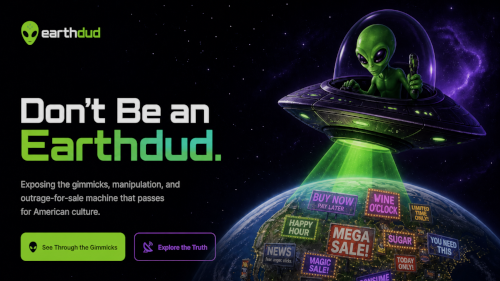
Don’t be an Earthdud.